For marketing agency owners
You thought agency life would get easier by now.
Another client would pay for the hire. The hire would take things off your plate. You have kept building, and the breathing room keeps moving.
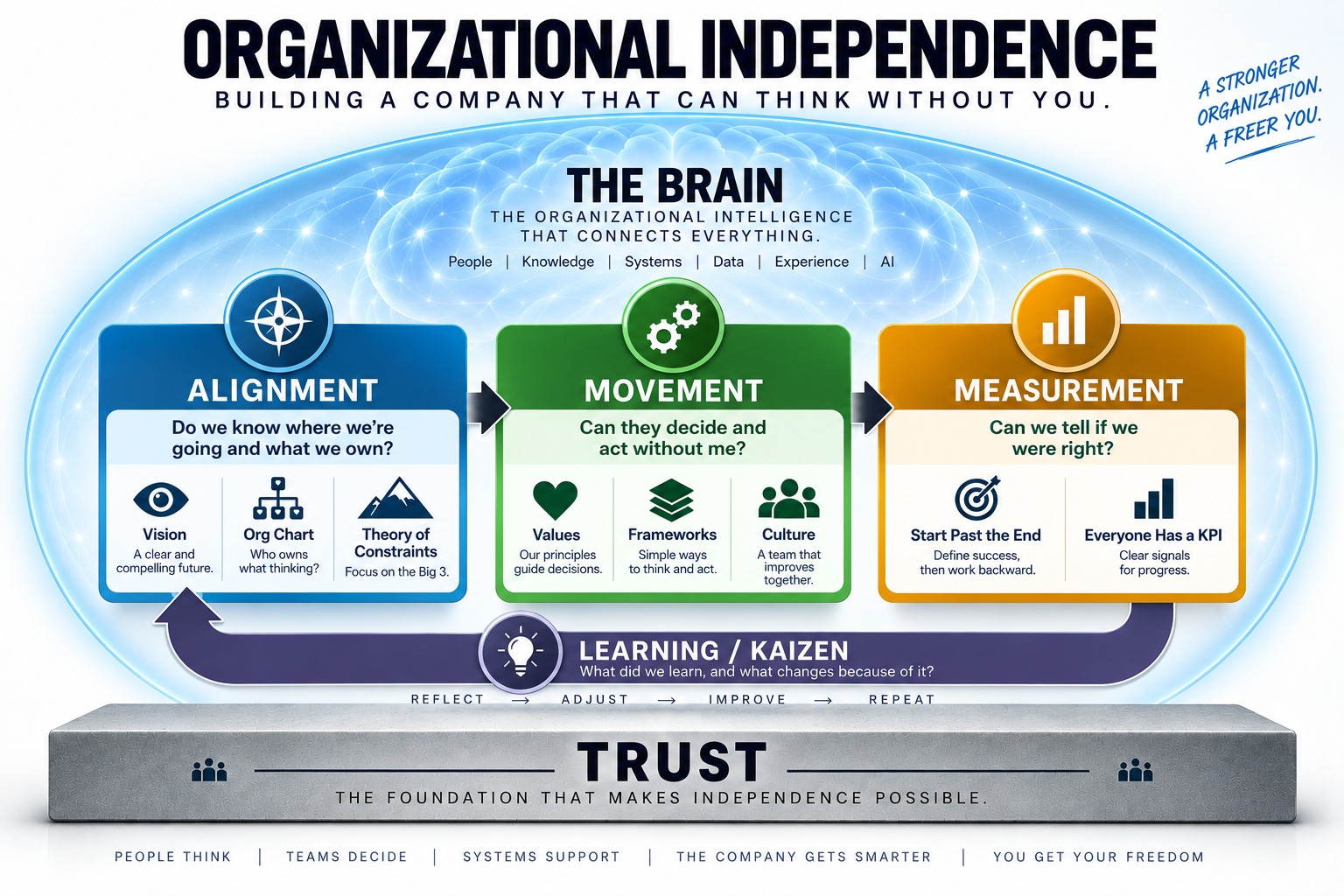
Impossible Means Go helps agency owners build a business that can grow and improve without demanding more and more of them. The method is Organizational Independence: building a company that can think without you.
Jump to: Vision · Values · Four capabilities · The org chart and its three roles · The whole framework on one page
Our story
Atiba thought it would get easier too
After more than 25 years in business, Atiba believed the team was the problem and he was the one who had to fix them. He had to outgrow that. The team needed direction and the authority to act. He needed to grow as a leader.
So we changed how our own agency works: how direction is shared, who decides, and how we know the result is good. We built Athena inside it to carry the management work. Here is what arrived:
A team that decides
2 of 313 questions from the team reached Atiba in two weeks. Everything else was answered without him.
Creatives who build
Our creative team now builds working apps for the business with Athena, apps that save us time and money.
Room to think
Quarterly planning that took two days now takes four hours.
When Atiba told this story in The Delegation Trap, owners kept asking how we built the team. Organizational Independence is the answer, and this page teaches all of it.
“Without you” does not mean unnecessary
Owners hear that phrase and hear you become unnecessary. Independence moves you off the work anyone else could do and onto the work only you can do, so the business stops waiting on you for things it should never have waited on you for.
The measure is not whether you can disappear. It is whether the company keeps finding better ways to reach its vision without you having to show it how. A company that only runs without you has a manager. A company that improves without you can think.
Your job becomes the architect’s. You start from a real problem, see the constraints around it, and design the path from where things are to where they should be. Capable people carry it out, adapt it, and often find a better route than the one you drew. The cycle is conceive, entrust, learn: design the path, hand it to people with the skill and the authority to steer it, and learn from what happens so the next design is better. Independence gives you the choice of how to contribute. Some owners design, some lead, some step away.
Three questions have to be answerable first, and each is a precondition for the next: movement without alignment is a team deciding quickly in the wrong direction, and measurement without movement measures a queue waiting on the owner.
Alignment
Do we know where we are going, and what we own?
A company cannot act without you until it knows the direction and who holds which piece of the thinking. Most owners have the direction and have never written it anywhere their team can reach it.
- Vision
- A clear and compelling future, written down.
- Org chart
- Who owns what thinking — not who reports to whom.
- Theory of Constraints
- Focus on the Big 3. Optimising anything that is not the constraint is waste.
Alignment · Vision
From clarity to independence
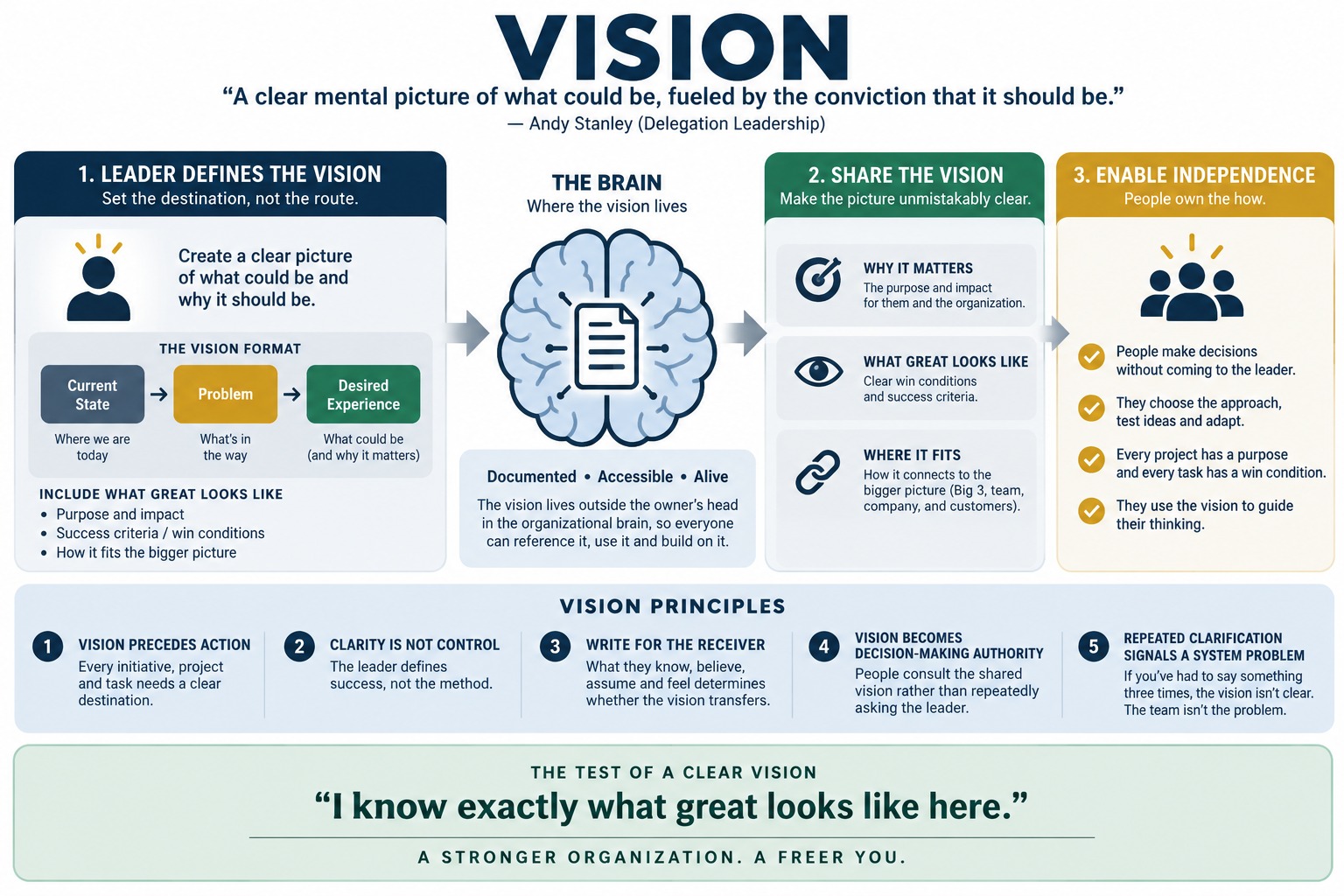
“A clear mental picture of what could be, fueled by the conviction that it should be.” Andy Stanley’s definition, and the one we use.
Most leaders never paint the picture at the level of the actual work, so the team comes back to them for it. Set the destination, not the route.

1 · Define it
A clear picture of what could be and why it should be. Written in three moves:
Current state — where we are today
Problem — what is in the way
Desired experience — what could be, and why it matters
2 · Share it
Make the picture unmistakable. Three things, every time:
Why it matters — the purpose and the impact, for them
What great looks like — the win conditions
Where it fits — how it connects to the Big 3, the team and the customer
3 · Enable independence
People own the how. You can tell it worked when:
- they decide without coming to you
- they choose the approach, test it and adapt
- every project has a purpose and every task has a win condition
- they use the vision to guide their thinking
And it lives in the Brain, not in your head
Documented · accessible · alive. A vision that exists only in the owner’s head can only be consulted by asking the owner.
A vision at every level of the work
The company’s vision is not enough on its own. Every initiative, project and task needs one sized to it, in the same three moves, so the person doing the work can choose between methods when conditions change.
- Company
- The future the company exists to bring about, and why it matters.
- Initiative
- The condition it must change, and how that moves the company’s vision.
- Project
- What success looks like for the people it affects, and how it serves the initiative.
- Task
- What great looks like in this piece of work, and how it serves the project.
You own the destination; your people own the route. The captain sets England as the destination. The navigator charts the course from Miami, the first mate handles the storms, and the engineer keeps the ship able to cross. Anyone may bring evidence that the destination is wrong, and you have to answer it. A conversation tells you whether someone understands the vision. What they decide when conditions change tells you whether they can use it.
Five principles
1 · Vision precedes action
Every initiative, project and task needs a clear destination.
2 · Clarity is not control
The leader defines success, not the method.
3 · Write for the receiver
What they know, believe, assume and feel decides whether the vision transfers.
4 · Vision becomes authority
People consult the shared vision instead of repeatedly asking the leader.
5 · Repeated clarification is a system problem
If you have said it three times, the vision is not clear. The team is not the problem.
The test of a clear vision
“I know exactly what great looks like here.”

Movement
Can they decide and act without me?
Values and frameworks tell someone how to decide when the situation departs from the instruction. This is where most companies stall: the people are capable, and every situation the handbook did not predict comes back to the owner.
- Values
- Our principles guide decisions — including the ones nobody wrote a process for.
- Frameworks
- Simple, repeatable ways to think and act.
- Culture
- A team that improves together rather than one that waits together.

Decide who decides, before the decision arrives
Set decision rights in advance, by how far a decision reaches, what it costs if it is wrong, and whether it can be undone.
- Where the company is going
- You, or the named vision owner, after hearing the people it affects.
- How a piece of work gets done
- The person or project owner, inside the values, budget and limits agreed.
- A process several teams share
- Its named owner, after consulting those teams, with a trial that can be undone.
- Stopping harm right now
- Whoever is closest to it. They contain it, then tell the owner.
- Challenging an assumption
- Anyone, with evidence. The owner has to answer it.
Local by default. A decision comes to you only when it would change the destination, cross a value, put a real cost on someone else, or go beyond the decider’s mandate. Everything else is theirs.
Movement · Values
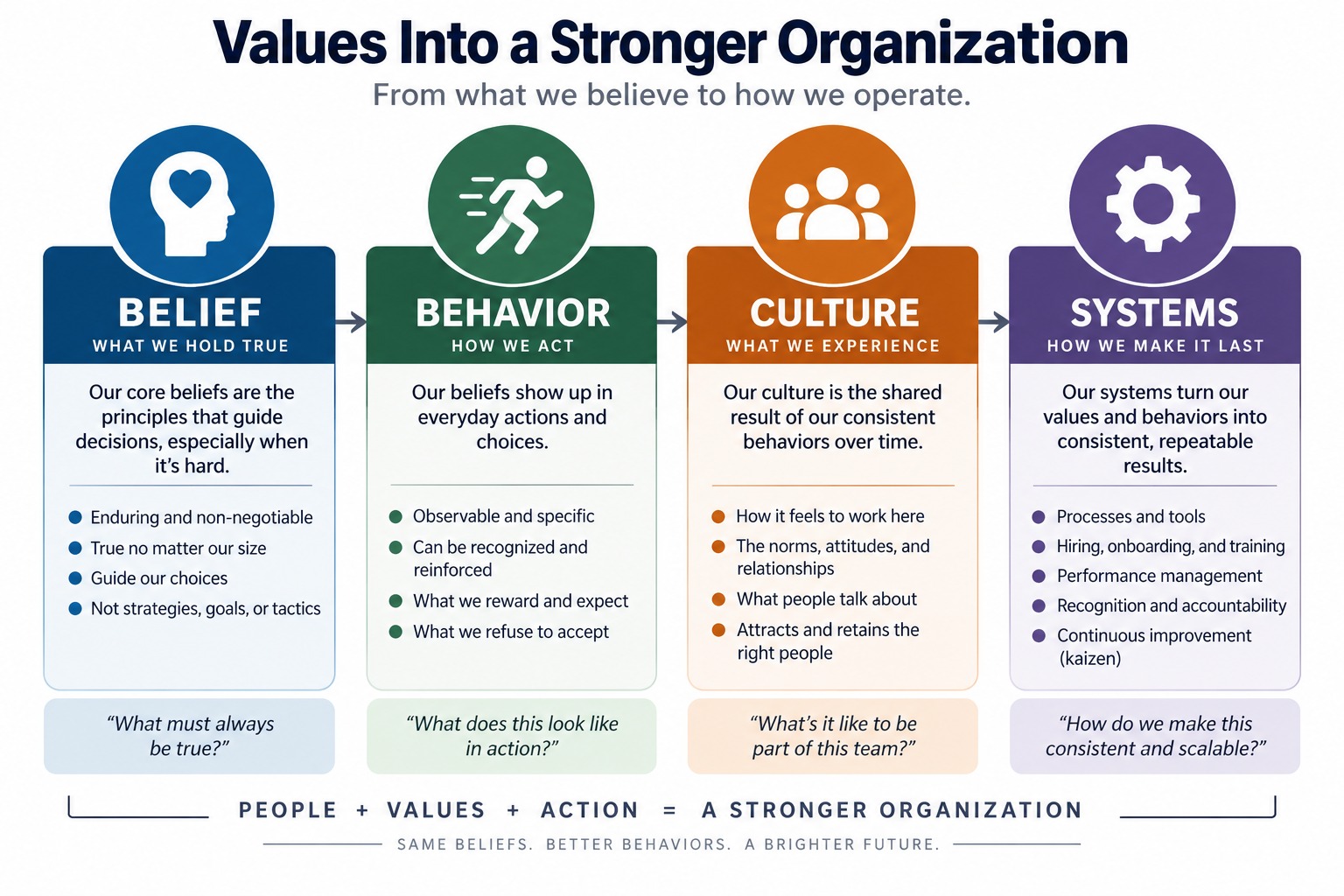
From what we believe to how we operate
A value painted on a wall changes nothing. It becomes an organization in four steps, and each one is a different question.
Belief
What we hold true
The principles that guide decisions, especially when it is hard.
- enduring and non-negotiable
- true no matter our size
- not strategies, goals or tactics
“What must always be true?”
Behaviour
How we act
Beliefs showing up in everyday actions and choices.
- observable and specific
- recognised and reinforced
- what we reward, and what we refuse to accept
“What does this look like in action?”
Culture
What we experience
The shared result of consistent behaviour over time.
- how it feels to work here
- the norms, attitudes and relationships
- what attracts and keeps the right people
“What is it like to be part of this team?”
Systems
How we make it last
What turns values and behaviours into repeatable results.
- processes and tools
- hiring, onboarding and training
- performance, recognition and accountability
- continuous improvement
“How do we make this consistent and scalable?”
People + values + action = a stronger organization

Measurement
Can we tell if we were right?
Define success first and work backward to the plan — start past the end. Then every seat carries one signal that says whether it is producing.
- Start past the end
- Define what success looks like, then work backward.
- Everyone has a KPI
- Clear signals for progress, one per seat.
What makes a KPI count
Most dashboards measure attendance. A KPI that counts measures what the seat produces, and it belongs to the position rather than the quarter: it survives a change of plan.
North star
One per seat. The single signal that says this position is doing its job.
Supporting measure
Explains the north star when it moves. Never a substitute for it.
Trigger
A number that says somebody has to act now, not a number to admire monthly.
Rejected on purpose
The activity metric is named and written down as rejected, so it cannot quietly become the goal.
Posts published, calls dialled, hours logged: all attendance. Qualified calls booked, gross margin per project, revenue per head: output.
The loop
Reflect, adjust, improve, repeat
Learning is a loop, not a fourth stage: it acts on all three and returns into Alignment, where a lesson becomes the next direction.
Improve is the move that does the work. A lesson noticed in a meeting and never written into how the company operates leaves next quarter starting where this one did.
Four capabilities of independence
Independence is not one switch. A company shows four capabilities, usually unevenly: strong in one department, absent in the next.
Execution
People complete and improve the work without being told again.
Decision
People resolve what is unclear and make sound choices within clear limits.
Architecture
People find what is holding the system back and redesign the process, rules or structure.
Transformation
The company finds, tests and adopts genuinely different ways to reach its vision.
A first test you can run this week
Pick one initiative that keeps coming back to you. Write its vision in three lines, name one value it must protect, and say who may change the path and where their authority ends. Let them try a bounded change and write down what they expect. At review, ask whether things improved, whether someone else paid a hidden cost, and whether the team can say what to keep or change without asking you. If they still need you, name what is missing: the skill, the information or the authority. Redesign the next attempt around it.
The mechanism
Every position holds three roles, and you have been filling the empty ones
We draw boxes, put positions in them, put names in the boxes we have hired for — and put our own name in every box we have not. That is why an owner feels like they are wearing all the hats.
Break any one position open and there are three roles inside it, each answering a different question.

Any position, opened up
Strategic
What should we do, and why that?
Tactical
Doing the thing.
Analytical
Did it work? Did we measure it, so we know how to do it better?
Most people do one of the three well. Exceptional people do two. So a hire frustrates you for not being strategic enough, or not analytical enough, when that is not who they are. The gap was in the chart before they arrived.
A restaurant owner once offered his sous chef as the counter-example: he only stirs the pot, nothing strategic about it. So who invented the Christmas specials? Well, I did. The strategic part of that position was the owner's. That is organizational dependence, arriving one position at a time.
AI fills one of the three. It does not fill a position. It was built by humans in their own image and it has the same limit: one role at a time, done well. If two roles on a position are empty, you build two things, not one thing doing both.
Over all three
The Brain
The organizational intelligence that connects everything — people, knowledge, systems, data, experience and AI — holding the vision, the values, the frameworks, the numbers and the lessons in one place a new person inherits on their first day.
It works as capture, connect, apply, learn, evolve. Without the connect step it is a filing cabinet. Without the apply step it is a library nobody visits.
Every stage depends on the company remembering something, and a company whose memory lives in the owner’s head can only think when the owner is in the room.
Under all three
Trust
The foundation that makes independence possible. A team that does not believe it is allowed to decide will keep asking, however good the framework is.
People think · Teams decide · Systems support · The company gets smarter · You get your freedom.
The test every build has to pass
Show me the money
Freedom is the promise. A number is the proof. A build has to meet both; one without the other fails in opposite directions.
It moves revenue or profit, measurably
A number someone could be shown. A build that does the work beautifully in your own voice and moves no number is a hobby with a budget.
It works your way
Your goals, your values, your frameworks. A build that moves a number by abandoning how your company operates buys a quarter and costs the thing that made the company worth running.
Bigger means revenue or profit, not more output or more staff. Faster is activity. Bigger is money. We build to increase the bottom line.

What was your last win supposed to make possible?
Talk it through with Atiba: what you expected, what actually changed, and what is holding the rest back.
Or start on your own: The AI Leverage Check, thirteen questions, four minutes, free.